This content was aggregated from local dealer data and insights provided by the USA Today Network Automotive Insights team using Google Gemini and the Vehicles For Sale Near West Palm Beach marketplace writing team.
For a solo commuter, buying more vehicle than necessary can mean paying for space and capability that rarely get used. The 2026 Honda Civic Hatchback takes a different approach, combining the manageable dimensions and efficiency of a compact car with a rear hatch that makes its cargo area considerably more useful for everyday life. For Stuart drivers balancing commuting, errands, beach trips, and occasional longer drives along Florida’s Treasure Coast, that flexibility gives the Civic Hatchback an appealing value proposition.
The bigger question is which version makes the most sense. The 2026 lineup offers a conventional gasoline Sport model as well as more powerful and efficient Sport Hybrid and Sport Touring Hybrid configurations, allowing shoppers to prioritize a lower entry point, hybrid efficiency, or additional comfort and technology.
The fundamental appeal of the 2026 Honda Civic Hatchback is straightforward: it delivers much of the easy-to-drive character of a compact sedan without committing the owner to a traditional trunk.
That distinction can matter for solo commuters. Most weekday trips may involve only a laptop bag, groceries, or gym equipment, but folding the rear seats expands the Civic Hatchback's usefulness when it is time to carry bulkier purchases, luggage, recreational equipment, or other awkwardly shaped cargo. The wide rear hatch can make loading those items simpler than working around a sedan's trunk opening.
There are three principal value points in the lineup.
Sport is the conventional gasoline choice. Its naturally aspirated 2.0-liter four-cylinder engine produces 150 horsepower and is paired with a continuously variable transmission. It makes sense for shoppers who like the Civic Hatchback's design and cargo flexibility but do not necessarily drive enough miles to make the hybrid system a priority.
Sport Hybrid is arguably the lineup's value sweet spot for frequent commuters. Its two-motor hybrid system delivers a combined 200 horsepower, giving drivers both greater output and substantially stronger efficiency potential than the conventional gasoline model. For someone commuting regularly around Stuart and the surrounding Treasure Coast, that combination is particularly relevant.
Sport Touring Hybrid retains the 200-horsepower hybrid powertrain while adding more premium cabin and technology features. Its value proposition is less about improving the basic transportation equation and more about making time behind the wheel more comfortable and connected.
For a buyer traveling alone most of the time, the middle Sport Hybrid deserves particularly close consideration. It provides the powertrain benefits that distinguish the upper Civic Hatchback models without requiring the shopper to select every available luxury-oriented feature.
The gasoline Sport uses Honda's 2.0-liter four-cylinder engine with 150 horsepower. It is the simpler powertrain choice and should provide enough performance for routine commuting, errands, and highway travel.
The Sport Hybrid and Sport Touring Hybrid take a different approach. Honda's two-motor hybrid system produces 200 total system horsepower, a substantial increase over the conventional Sport.
For Stuart commuters, the advantage is not simply the horsepower number. Electric-motor assistance provides responsive acceleration, which can be useful when entering faster-moving roads, merging onto I-95, or adjusting speed in changing traffic.
The hybrid also makes particular sense in stop-and-go driving because electrification can recover energy through regenerative braking rather than relying exclusively on the gasoline engine.
Fuel economy is one of the strongest arguments for moving from the gasoline Sport to a Civic Hatchback hybrid.
EPA estimates can vary by configuration, so shoppers should verify the window label for the specific vehicle they are considering. Broadly, however, the hybrid Civic Hatchback is designed to deliver a significant efficiency advantage over the conventional 2.0-liter model, particularly in urban and mixed driving.
That changes the value calculation for a solo commuter. A driver covering relatively few miles may reasonably prefer the lower-cost gasoline model. Someone driving to work five days a week, adding weekend trips, and keeping the car for several years has more opportunity to benefit from the hybrid's reduced fuel consumption.
Cargo utility is where the Civic Hatchback differentiates itself most clearly from the Civic Sedan.
The rear liftgate provides a large opening for loading cargo, while the folding rear seatbacks allow owners to trade unused passenger space for additional carrying flexibility. That is an especially logical arrangement for solo drivers: most of the time, the rear seats remain available for passengers, but they can become cargo space whenever necessary.
That flexibility can accommodate everyday situations ranging from groceries and luggage to larger purchases and recreational gear without requiring the footprint of a crossover.
Equipment varies substantially by trim, making technology an important part of the buying decision.
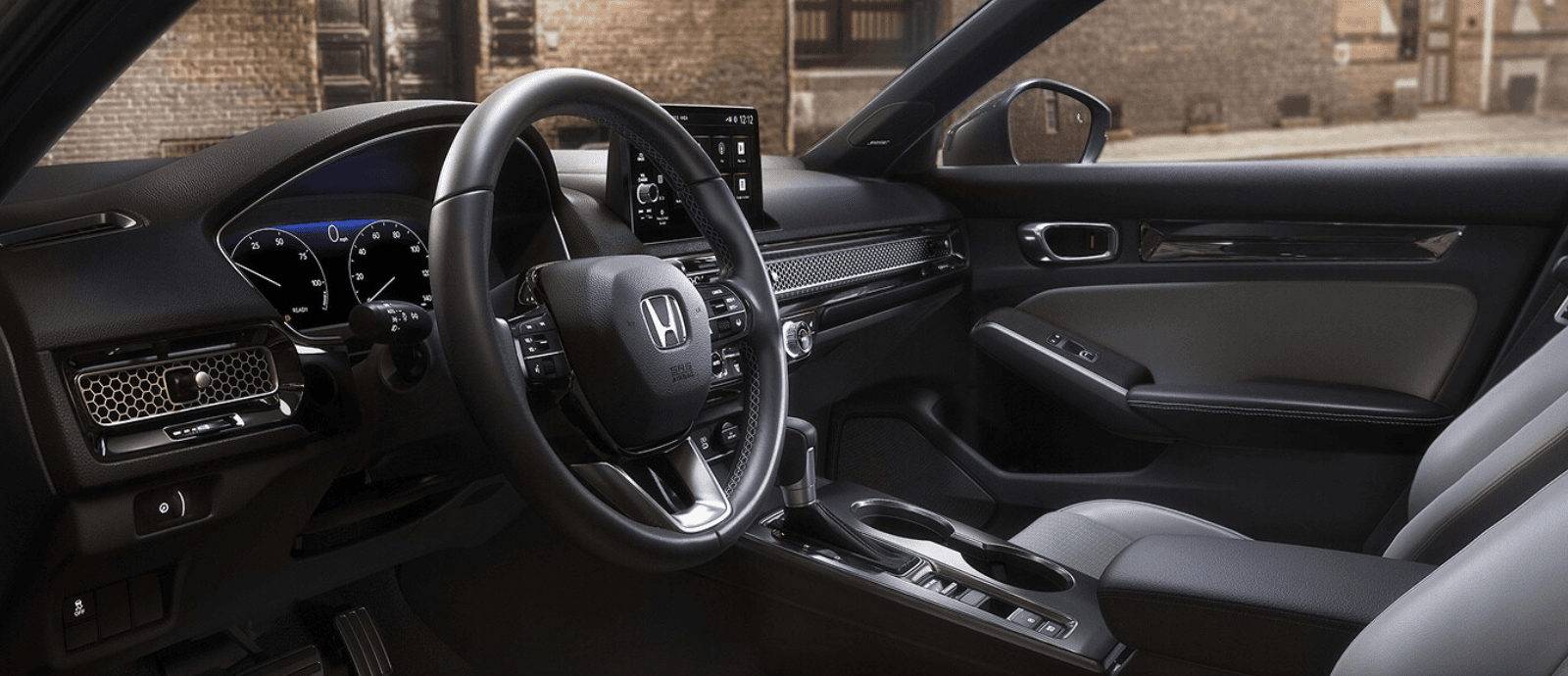
The Sport provides the essentials expected from a modern compact commuter, including smartphone integration and a touchscreen infotainment interface. Moving through the hybrid lineup adds convenience and comfort equipment, while the Sport Touring Hybrid serves as the technology-focused flagship.
Among the Sport Touring Hybrid's notable available equipment are a larger infotainment display, Google built-in capability, wireless Apple CarPlay and Android Auto compatibility, and a Bose premium audio system.
A commuter who spends significant time in the car may place more value on those upgrades than someone whose typical drive lasts only a few minutes.
The Civic also benefits from Honda Sensing driver-assistance and active-safety technology. Depending on operating conditions, these systems are designed to assist the driver with functions such as collision mitigation, lane management, and maintaining appropriate speed and following distance.
Features such as adaptive cruise control can be especially useful on longer stretches of highway, while lane-related assistance adds another layer of support during routine commuting.
These systems remain driver aids rather than substitutes for attentive driving, particularly in Florida's heavy rain, glare, and rapidly changing traffic conditions.
Rather than looking only at the initial purchase price, Civic Hatchback shoppers should consider what each step up the range actually buys.
Trim | Powertrain | Output | Value Position | Best Fit |
Sport | 2.0L gasoline four-cylinder | 150 hp | Lowest-cost route into the Civic Hatchback lineup | Lower-mileage drivers prioritizing purchase price and hatchback utility |
Sport Hybrid | Two-motor hybrid | 200 hp combined | Adds stronger performance and greater fuel-efficiency potential | Frequent commuters seeking the strongest balance of efficiency, power, and equipment |
Sport Touring Hybrid | Two-motor hybrid | 200 hp combined | Adds premium technology, comfort, and audio features | Drivers who want hybrid efficiency with the most upscale Civic Hatchback experience |
Exact MSRP, destination charges, options, taxes, dealer fees, and incentives can change, so buyers should consult current manufacturer pricing and individual listings when comparing actual costs.
The more useful question is whether each upgrade aligns with the owner's driving habits.
For the Sport, the argument is simplicity and entry value. A Stuart resident working close to home, driving relatively few annual miles, or simply preferring the conventional gasoline powertrain may have little reason to pay more solely for improved fuel economy.
The Sport Hybrid changes the equation for higher-mileage commuters. It combines 200 horsepower with hybrid efficiency, meaning the buyer is not merely paying extra to consume less fuel. The upgrade also produces a meaningful performance benefit.
The Sport Touring Hybrid is more of a comfort-and-technology decision. It uses the same basic 200-horsepower hybrid formula as the Sport Hybrid, so the additional expense goes primarily toward higher-level amenities rather than another major jump in power or efficiency.
That makes the Sport Hybrid particularly compelling from a pure value perspective, while the Sport Touring Hybrid can justify its premium for buyers who expect to keep the vehicle for years and know they will appreciate its upgraded cabin every day.
Stuart's driving environment suits many of the Civic Hatchback's strengths.
The car's compact exterior dimensions should make it easier to maneuver through parking areas and busier commercial districts than a larger SUV. At the same time, the hatchback configuration means downsizing the vehicle does not necessarily require giving up practical cargo flexibility.
Florida weather also deserves consideration. Air conditioning is a major part of everyday vehicle use for much of the year, and shoppers should evaluate cabin comfort during a test drive rather than focusing only on specifications. Drivers choosing higher trims may find comfort upgrades especially worthwhile when spending substantial time commuting.
Heavy seasonal rain is another local consideration. The Civic's driver-assistance technologies can provide useful support, but wet roads still demand additional following distance and careful speed management. No active-safety system changes the basic limits of tire traction or visibility.
For drivers making regular trips beyond Stuart, the Civic Hatchback also has an advantage over vehicles optimized exclusively for city use. Its combination of compact dimensions, highway-friendly performance, available hybrid efficiency, and usable cargo room makes it suitable for longer Treasure Coast and South Florida drives.
The hybrid models are particularly attractive for motorists whose routine includes a mixture of local streets and longer highway stretches.
For a solo commuter, however, perhaps the most important ownership benefit is versatility without excess size. You do not need a large vehicle every morning simply because you occasionally need extra cargo room. The Civic Hatchback lets its rear seating area serve passengers when needed and supplement cargo capacity when it is not.
For many Stuart solo commuters, yes—provided the hatchback flexibility will actually be used.
Someone who carries little more than a backpack and rarely folds the rear seats should also compare the Civic Sedan. But drivers who routinely carry groceries, luggage, hobbies, larger purchases, or recreational gear gain genuine everyday utility from the hatchback body style without moving into a larger crossover.
Within the Civic Hatchback range, the Sport offers the most straightforward path to that versatility. The Sport Hybrid makes a strong case for frequent commuters because its hybrid system combines higher output with better efficiency potential. The Sport Touring Hybrid is the choice for shoppers willing to spend more for premium technology and cabin amenities.
Ultimately, the Civic Hatchback's appeal is not that a solo driver needs additional space every day. It is that the space is available when needed without imposing the size, weight, and packaging of a larger vehicle on every commute.
The Sport Hybrid is likely to offer the most compelling balance for frequent commuters because its two-motor hybrid system produces 200 total system horsepower while emphasizing fuel efficiency. Lower-mileage drivers may find the gasoline Sport more economical to purchase, while the Sport Touring Hybrid makes more sense for shoppers who prioritize premium technology and comfort.
The gasoline Civic Hatchback Sport uses a 2.0-liter four-cylinder engine producing 150 horsepower. Sport Hybrid and Sport Touring Hybrid models use Honda's two-motor hybrid system and produce 200 total system horsepower. That gives the hybrid models a substantial performance advantage in addition to their fuel-efficiency benefits.
Yes. The liftgate and folding rear seatbacks make the Civic Hatchback particularly useful for a driver who does not need SUV-size passenger capacity but occasionally carries bulky belongings. Luggage, groceries, beach equipment, and other recreational gear can be easier to load through a hatch than through a conventional sedan trunk.
It depends on which features matter to you. Both use a 200-horsepower hybrid powertrain, so the Sport Touring Hybrid's value comes largely from its additional comfort, infotainment, connectivity, and premium audio equipment. Drivers primarily interested in hybrid performance and efficiency may find the Sport Hybrid the stronger value proposition.
Not necessarily. Drivers who rarely carry large objects may be perfectly well served by a sedan. The hatchback becomes more valuable when you regularly need adaptable cargo space but do not want a crossover. For a solo driver, folding unused rear seats can turn passenger space into useful cargo capacity whenever circumstances demand it.
The best Civic Hatchback trim depends on how far you commute, how much cargo flexibility you need, and whether hybrid efficiency or premium equipment justifies moving higher in the lineup. Comparing the Sport, Sport Hybrid, and Sport Touring Hybrid side by side can help determine which features are worth paying for based on your own driving habits.
Browse 2026 Honda Civic Hatchback for sale near Stuart to compare current listings, configurations, and vehicle details.
You can also learn more about Johnson Honda of Stuart and explore dealership information before planning your next step.
Written for http://vehiclesforsalenearwestpalmbeach.com/
By the USA TODAY Network Automotive Insights Team, in collaboration with Johnson Honda of Stuart and the Vehicles For Sale Near West Palm Beach - The Palm Beach Post.
Disclaimer: This article's content is intended for informational purposes only. Vehicle specifications and features are based on data provided by J.D. Power and local dealerships and may vary by individual vehicle, VIN, trim, configuration, packages, and optional equipment. Vehicle images may not depict the exact model, trim, features, packages, accessories, or specifications described. Vehicle pricing, availability, features, and specifications are subject to change without notice. Please reference the dealership's vehicle listing and window sticker or consult the dealership directly for complete and accurate details.